
Product Description
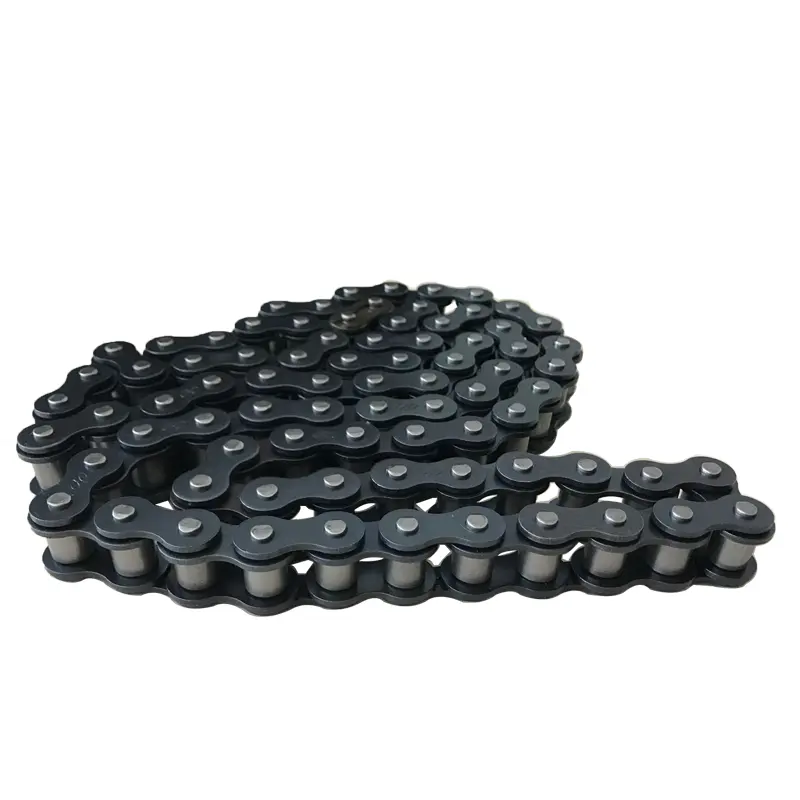
Roller chain is a power transmisssion component.It is composed by 4 parts.They are plate,roller,bush and pin.
The materials are as follow:
Plate:40Mn,45Mn,40Cr.
Roller:10#,20#,45#,40Cr.
Bush:10#,20#.
Pin:20CrMnMo,30CrMnTi,40Cr.
Roller chains are widely used for general industrial applications.They are available in simplex, duplex and triplex with riveted or cottered.
We provides a significant roller chain advantage for hundreds of applications coping with operating conditions that are hot or cold, wet or dry, dusty or requiring cleanliness and all of these solutions combine excellent wear resistance and fatigue resistance with a long, reliable working life.
Product Description
Roller chain:
Roller chain or bush roller chain is the type of chain drive most commonly used for transmission of mechanical power on many kinds of domestic, industrial and agricultural machinery, including conveyors, wire- and tube-drawing machines, printing presses, cars, motorcycles, and bicycles. It consists of a series of short cylindrical rollers held together by side links. It is driven by a toothed wheel called a sprocket. It is a simple, reliable, and efficient means of power transmiss
| Our Main product Series | |||
| Roller Chains | Conveyor Chain | Agricultural Chain | Special chains |
| Short pitch precision roller chain(A series) | Lumber conveyor chain | S type steel agricultural chains | Forged chain |
| Short pitch precision roller chain(B series) | M-series conveyor chain | CA type steel agricultural chains | Side bow chain |
| Double pitch roller chain | MT series conveyor chain | A type steel agricultural chains | Sewage treatment chain |
| Hollow pin chain | MC series conveyor chain | ZGS38 Combine harvester chains | Sharp top chain |
| Heavy type chain | FV series conveyor chain | Self-lubrication chain | |
| Straight plate chain | Accumulation chain | Extended pin chain | |
| Flat-top chain | Spike chain | ||
| Chain attachment | |||
European Standard Roller Chains
1. BS/DIN Standard Short Pitch Power Transmission Roller Chains: 03B-48B
2. BS/DIN Standard Short Pitch High Performance Roller Chain
(all parts made of special alloy steel, with CZPT seamless bushes and wide waist linkplates)
3. BS/DIN Standard Short Pitch Self-Lubricating Roller Chains (Maintenance Free Chains)
4. BS/DIN Standard Marine Engine Roller Chains (Marine Engine Chain): 32BM-72BMBS/DIN Standard Short Pitch Straight Linkplate Roller Chains: C08B-C48B
5. BS/DIN Standard Short Pitch Bushed Chains (Rollerless)
6. BS/DIN Standard Double Pitch Transmission Roller Chains: 208B-232BL
American Standard Roller Chains
1. ANSI Standard Short Pitch Power Transmission Roller Chains (and Bushed Chains as well): 25-240
2. ANSI Standard Short Pitch High Performance Roller Chain
(all parts made of special alloy steel, with CZPT seamless bushes and wide waist linkplates)
3. ANSI Standard Short Pitch Straight Linkplate Roller Chains: C40-C240
4. ANSI Standard Short Pitch Heavy Duty Roller Chains: 60H-240H
5. T Series Super Roller Chains: T40-T140
6. HT Series Super Roller Chains: HT60-HT140
7. CZPT Series Super Roller Chains: SHT80-SHT140
8. ANSI Standard Short Pitch Bushed Chains (Rollerless)
9. Roller Chains for Chain Couplings: 4012-12571
10. ANSI Standard Double Pitch Transmission Roller Chains: A2040-A2120
|
Shipping Cost:
Estimated freight per unit. |
To be negotiated |
|---|
| Standard or Nonstandard: | Standard |
|---|---|
| Application: | Textile Machinery, Garment Machinery, Conveyer Equipment, Packaging Machinery, Electric Cars, Motorcycle, Food Machinery, Marine, Mining Equipment, Agricultural Machinery, Car |
| Surface Treatment: | Nickel Plating |
| Samples: |
US$ 10/Piece
1 Piece(Min.Order) | Order Sample |
|---|
| Customization: |
Available
| Customized Request |
|---|
How do roller chains handle side loads?
Roller chains are designed to primarily handle axial (or in-line) loads, which are forces applied along the axis of the chain. However, they do have some capability to handle limited side loads. Here’s a detailed answer to the question:
1. Roller Design: The rollers in a roller chain are cylindrical in shape and rotate freely between the inner and outer plates. This design allows the chain to accommodate limited side loads by allowing the rollers to roll and adjust their position within the chain.
2. Bearing Surfaces: Roller chains have bearing surfaces between the pins and the bushings or rollers. These bearing surfaces help distribute the load and reduce friction, allowing the chain to handle some degree of side loads.
3. Tolerance for Misalignment: Roller chains have some tolerance for misalignment between the sprockets, which can help compensate for minor side loads. However, excessive misalignment can lead to increased wear and decreased chain life.
4. Limitations: It’s important to note that roller chains are primarily designed for transmitting power and handling axial loads. While they can tolerate some side loads, their ability to handle significant side loads is limited. Excessive side loads can cause increased wear, premature chain failure, and reduced overall performance.
To ensure the longevity and reliable performance of a roller chain, it is essential to minimize side loads as much as possible. Proper alignment of the sprockets, appropriate tensioning of the chain, and avoiding excessive side loads are important considerations when using roller chains in an application.
How do roller chains handle static loads?
Roller chains are primarily designed for transmitting power and handling dynamic loads, which involve motion and varying forces. However, roller chains can also handle static loads to some extent. Here’s a detailed answer to the question:
1. Load Distribution: When a roller chain is subjected to static loads, the weight or force is evenly distributed across multiple rollers and pins. This helps to distribute the load more effectively and reduces stress concentrations on individual components. The load is transferred from one roller to another through the pins, ensuring a more balanced distribution.
2. Stiffness: Roller chains possess a certain degree of stiffness that enables them to resist static loads. The rigid construction of the chain, including the link plates and pins, helps maintain the integrity of the chain under static conditions. This stiffness allows the chain to support the applied load without excessive elongation or deformation.
3. Lubrication: Proper lubrication is essential for roller chains to handle static loads effectively. Lubrication helps reduce friction and wear, which can occur even under static conditions due to the weight of the load. Adequate lubrication ensures smooth movement of the chain and minimizes the risk of surface damage or increased friction during load-bearing.
4. Chain Preload: In some cases, applying a pre-load or initial tension to the roller chain can help improve its ability to handle static loads. The pre-load helps to eliminate any slack or looseness in the chain, enhancing its rigidity and reducing the potential for excessive elongation or misalignment when subjected to static forces.
While roller chains can handle static loads, it’s important to note that they are primarily designed for dynamic applications involving motion. Excessive static loads or prolonged exposure to static conditions may lead to increased wear, elongation, or deformation of the chain. In scenarios where the majority of the load is static, alternative power transmission systems or load-bearing mechanisms may be more suitable.
What are the advantages of using a roller chain in machinery?
A roller chain offers several advantages when used in machinery. Here’s a detailed answer to the question:
1. High Load Capacity: Roller chains are designed to handle high loads and transmit power efficiently. They are capable of carrying heavy loads and withstanding high torque, making them suitable for applications that require reliable power transmission.
2. Wide Speed Range: Roller chains can operate at a wide range of speeds, from low to high. They are capable of handling both slow-speed and high-speed applications, providing flexibility in machinery design and operation.
3. Durability and Longevity: Roller chains are known for their durability and long service life. They are constructed using high-quality materials and undergo precise manufacturing processes, resulting in chains that can withstand heavy use, harsh environments, and repetitive motions without premature failure.
4. Easy Installation and Maintenance: Roller chains are relatively easy to install and maintain. They have a simple design and can be quickly assembled onto sprockets. Routine maintenance involves lubrication, periodic inspections, and occasional tension adjustments, which are straightforward tasks.
5. Versatility: Roller chains are versatile and can be used in a wide range of machinery and equipment. They find applications in various industries, including automotive, agriculture, manufacturing, construction, and more. They can be customized to meet specific requirements by selecting the appropriate type, size, and configuration.
6. Efficient Power Transmission: Roller chains provide efficient power transmission between the driving and driven components. The rolling action of the chain on the sprockets reduces friction and energy losses, resulting in higher mechanical efficiency compared to other types of power transmission methods.
7. Compact Design: Roller chains have a compact design, which allows for efficient power transmission in tight spaces. They occupy less space compared to other types of power transmission systems, making them suitable for machinery with space constraints.
8. Cost-Effective Solution: Roller chains are a cost-effective solution for power transmission in machinery. They are relatively inexpensive compared to alternative power transmission methods and offer a high level of reliability and longevity, resulting in lower maintenance and replacement costs over time.
Overall, the advantages of using roller chains in machinery include their high load capacity, wide speed range, durability, ease of installation and maintenance, versatility, efficient power transmission, compact design, and cost-effectiveness. These factors make roller chains a popular choice for many machinery applications.


editor by CX 2023-09-11